Here’s Why Every REALTOR® Should Pay Attention
How the latest TREC disclosure changes impact your transactions, your clients, and why having an experienced, licensed Transaction Coordinator has never been more valuable.
If you’ve been following our recent blog series, you already know that 2026 has been one of the biggest years for Texas real estate contract changes in recent memory.
In our previous articles, we covered:
- 2026 TREC Contract Changes Are Coming: Why Experienced Transaction Coordinators Matter More Than Ever
- The New TREC Contracts Are Officially Here: Don’t Let Your Next Transaction Go Out With a Bang
As of July 1, 2026, the new TREC contract forms officially became mandatory for Texas real estate transactions. But there’s another important update that many REALTORS® are still overlooking:
The Seller’s Disclosure Notice was also updated.
While much of the industry focused on contract revisions, compensation language, and new forms, the Seller’s Disclosure Notice (TREC Form 55-1) quietly received several significant additions that can directly affect buyers, sellers, negotiations, and even a property’s marketability.
These aren’t cosmetic changes.
They’re designed to provide buyers with more meaningful information before they make one of the largest purchases of their lives.
As Transaction Coordinators who work on hundreds of Texas transactions every year, we’ve already incorporated these changes into our workflows because staying ahead of TREC updates isn’t optional—it’s part of the value we provide our agents every single day.
Why Was the Seller’s Disclosure Updated?
The changes originated from recommendations made by the Texas Sunset Advisory Commission, which directed TREC to require additional disclosures that could materially affect a property’s value or desirability.
The goal?
Simply put…
Give buyers more transparency.
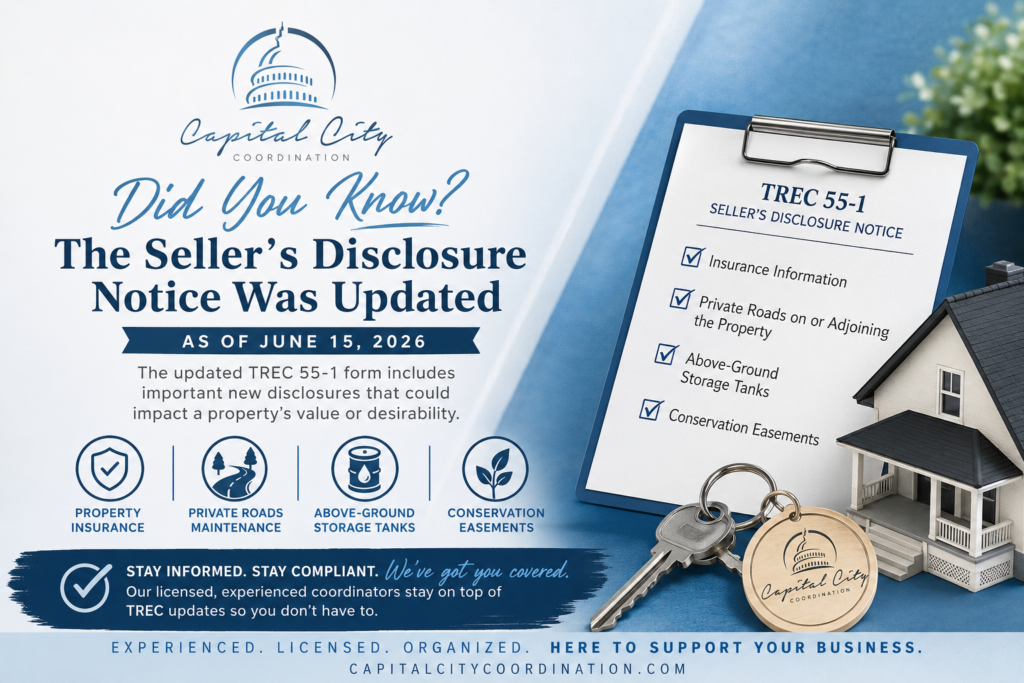
TREC responded by expanding Paragraph 9 of the Seller’s Disclosure Notice to include additional information regarding:
- Property insurance
- Private road maintenance responsibilities
- Above-ground storage tanks
- Conservation easements
These additions were adopted as part of the broader 2026 TREC form revisions.
Let’s Break Down the New Disclosure Requirements
1. Property Insurance Information
One of the biggest additions involves insurance.
With insurance premiums climbing across Texas and some homes becoming increasingly difficult or expensive to insure buyers are paying much closer attention to insurance history.
The updated disclosure asks sellers to provide additional information regarding insurance that may affect the property’s desirability.
Why does this matter?
Today’s buyers often discover insurance issues after they have already negotiated the contract.
Now these conversations can happen much earlier.
This creates:
- Better transparency
- Better expectations
- Fewer surprises
- Better-informed purchasing decisions
Considering the dramatic changes occurring within the Texas insurance market over the past several years, this is a timely addition to the disclosure process.
2. Private Roads
This update will especially impact rural properties, ranches, acreage, and Hill Country homes.
The disclosure now asks whether there are private roads on or adjoining the property that the buyer would be responsible for maintaining.
Many buyers assume roads are maintained by:
- the county
- the city
- an HOA
That isn’t always true.
Maintenance obligations can become expensive and sometimes involve shared agreements—or no agreements at all.
Knowing this before closing helps buyers make informed decisions and understand future ownership responsibilities.
3. Above-Ground Storage Tanks
Another addition asks sellers to disclose the existence of certain above-ground storage tanks.
While this may not affect every suburban home, it is common on:
- ranch properties
- agricultural properties
- larger acreage
- rural homes
Storage tanks may involve:
- propane
- fuel
- chemicals
These can have environmental implications, lender considerations, or future maintenance responsibilities that buyers deserve to know before purchasing.
4. Conservation Easements
Perhaps one of the lesser-known additions involves conservation easements.
Many homeowners have never heard the term.
A conservation easement is a legal restriction that limits certain uses of land in order to preserve natural resources or open space.
While these easements can provide tremendous environmental benefits, they may also restrict future development or property use.
That’s valuable information for any buyer considering the long-term potential of a property.
Now that information is specifically addressed within the Seller’s Disclosure Notice.
These Aren’t Just “More Boxes”
Some agents see updated forms and think…
“Great…more paperwork.”
But that’s not what these changes are about.
Each addition represents information that could materially influence:
- a buyer’s purchasing decision
- financing
- insurance availability
- future expenses
- property value
- negotiations
Good disclosures don’t kill deals.
Unexpected surprises do.
The more transparent everyone is upfront, the smoother the transaction typically becomes.
Why This Matters for REALTORS®
Every contract revision requires agents to learn something new.
This year alone we’ve seen updates involving:
- contract language
- compensation
- notice delivery
- legal holidays
- new addenda
- groundwater and surface water disclosures
- Seller’s Disclosure revisions
That’s a lot to absorb while simultaneously:
- prospecting
- showing homes
- negotiating offers
- managing inspections
- keeping clients happy
- running a business
Most REALTORS® didn’t get into real estate because they love paperwork.
They got into real estate because they love helping people.
That’s where experienced Transaction Coordinators make a tremendous difference.
At Capital City Coordination, Staying Current Is Part of Our Job
One question we hear often is:
“How do you keep up with all these changes?”
The answer is simple.
Because it’s our responsibility.
Our team continuously monitors:
- TREC updates
- Texas REALTORS® changes
- contract revisions
- promulgated forms
- legal education
- industry best practices
We don’t wait until a change becomes mandatory.
We’re reviewing proposed updates, attending education, comparing redline versions, updating workflows, revising checklists, and training our coordinators well before implementation.
By the time new forms become mandatory, they’re already built into the systems we use every day.
That preparation gives our agents confidence that someone is paying attention to the details.
Why Every Coordinator on Our Team Is a Licensed Texas REALTOR®
This is something that makes Capital City Coordination different.
Every Transaction Coordinator on our team is a licensed Texas REALTOR® with years of real-world industry experience.
That doesn’t mean we’re competing with agents.
Quite the opposite.
We intentionally do not actively sell real estate.
We maintain our licenses because we believe our agents deserve coordinators who truly understand:
- TREC contracts
- promulgated forms
- timelines
- amendments
- disclosures
- compliance
- industry changes
Our license isn’t used to compete.
It’s used to better support the agents we serve.
That’s an important distinction.
Our focus is helping agents deliver an exceptional client experience—not building our own real estate business.
Our success comes from making our agents more successful.
Experience Matters
Could someone learn how to manage deadlines?
Sure.
Could someone learn how to upload documents?
Absolutely.
But understanding why a form changed…
Recognizing how a revised disclosure impacts a transaction…
Knowing when something looks inconsistent…
Those are skills developed through years of real estate experience.
That’s why our coordinators aren’t simply administrative assistants.
They’re experienced real estate professionals supporting agents behind the scenes.
The Value of a Second Set of Experienced Eyes
No Transaction Coordinator replaces an agent.
Nor should they.
The agent remains responsible for representing their client and making brokerage decisions.
But having another experienced, licensed professional reviewing the transaction often helps identify issues before they become larger problems.
That additional layer of review creates confidence for everyone involved.
Our Goal Is Simple
We want our agents focused on what they do best:
- building relationships
- negotiating contracts
- serving clients
- growing their businesses
We’ll handle the organization, documentation, deadlines, communication, and evolving paperwork behind the scenes.
Because every hour an agent spends researching form revisions is an hour they aren’t serving clients or generating business.
Looking Ahead
If the past few years have taught us anything, it’s this:
Texas real estate forms will continue evolving.
Regulations change.
Disclosure requirements change.
Industry expectations change.
The agents who stay informed and surround themselves with knowledgeable professionals will continue delivering exceptional service.
That’s exactly why we invest so heavily in ongoing education and process improvement.
Final Thoughts
The updated Seller’s Disclosure Notice may not have received as much attention as the July 1 contract revisions, but it’s another important reminder that Texas real estate is constantly evolving.
The additional disclosures surrounding:
- insurance
- private roads
- above-ground storage tanks
- conservation easements
are designed to create greater transparency and better-informed transactions for everyone involved.
For REALTORS®, staying ahead of these changes isn’t just about compliance, it’s about professionalism, protecting clients, and delivering a seamless transaction experience.
At Capital City Coordination, that’s exactly what we do every day.
Our licensed, experienced Transaction Coordinators remain committed to staying current with TREC updates, contract revisions, and industry best practices so our agents don’t have to navigate those changes alone.
When you partner with Capital City Coordination, you’re not hiring someone to simply check boxes or track dates.
You’re partnering with a team of seasoned Texas real estate professionals who understand the contracts, respect the details, stay educated on the latest changes, and are dedicated to supporting, not competing with, your business.
Because when Texas real estate changes…
We’re already ready.